Choosing the 2026 best Titanium Mesh For Cranial Repair supplier takes more than comparing prices or product photos. The mesh must suit the defect, support accurate contouring, and come with clear documentation. Small details matter: the edge finish, the shape of each opening, and how consistently sheets match their specifications. A product can look impressive on a catalog page. The clinical fit still needs careful review.
This comparison focuses on practical supplier questions. Does the supplier provide traceable product information? Are dimensions and material details clearly stated? Can its team answer technical questions without vague promises? These points help procurement teams and clinical professionals assess options more consistently. They do not replace clinical judgment or evaluation of the finished device. Each case is different.
Expert insight matters, too. No source material or verifiable quotation was provided, so I will not invent a direct quote or attribute one to a named specialist. That is an important limitation. A sourced statement from a qualified cranial-reconstruction expert should be added before publication. The following guide can still help readers compare suppliers, identify missing information, and ask sharper questions. Look beyond the brochure. Examine the evidence.
2026 Best Titanium Mesh for Cranial Repair Suppliers?
Define Cranial Mesh Materials: ASTM F67 CP-Ti vs ASTM F136 Ti-6Al-4V ELI
Cranial mesh selection starts with the material specification, not the supplier’s headline. ASTM F67 covers commercially pure titanium for surgical implants. ASTM F136 covers wrought Ti-6Al-4V ELI, an extra-low-interstitial alloy. Both are used in implant applications, but they are not interchangeable grades.
CP titanium is often valued for its ductility and formability, useful when mesh needs careful contouring. F136 generally offers higher strength, which may matter for thin, load-bearing designs. ELI chemistry limits interstitial elements to support toughness. Still, actual performance depends on thickness, pore pattern, manufacturing, and finishing. Small differences matter. A rough edge or poorly controlled opening can affect handling and fit.
Tips: Check material certificates, traceability, and test records against the stated ASTM grade. Ask about mesh thickness, pore dimensions, edge finishing, and sterilization validation. Compare the device design with the surgical plan and relevant clinical requirements. These checks help, but material grade alone cannot determine suitability; the treating team must assess the individual case.
Minimum specified tensile strength (MPa): ASTM F67 Grade 4 compared with ASTM F136 titanium alloy.
ASTM F67 covers unalloyed titanium grades 1–4; this chart uses Grade 4, whose minimum tensile strength is 550 MPa. ASTM F136 specifies a minimum of 860 MPa for Ti-6Al-4V ELI. These are material specification minimums, not test results for a particular mesh product or a measure of clinical suitability. Sources: ASTM F67 and ASTM F136.
Ti-6Al-4V has a density of about 4.43 g/cm³ and an elastic modulus near 110 GPa. These figures help frame comparisons between cranial mesh materials, but they do not predict clinical performance alone. A supplier’s technical data should identify the alloy, product form, and measurement method. Small differences in mesh thickness can affect weight and handling. Geometry matters.
For cranial repair, compare pore size, strand width, edge finish, and contouring behavior alongside the stated modulus. A mesh that looks open on a drawing may behave differently after bending. Ask for dimensional tolerances and inspection records, not just a headline specification. Request evidence of material traceability and validated cleaning or sterilization processes. Details count.
The 110 GPa value describes material stiffness, not the stiffness of a finished mesh. Hole pattern, thickness, and fixation points also influence how a construct responds to load. That distinction is easy to miss. It is worth checking whether supplier test data applies to the actual mesh configuration being considered. Published values can vary with test conditions, so comparisons need matched methods. I would not treat a single density or modulus figure as a verdict; it is a starting point for a careful technical review.
2026 Best Titanium Mesh for Cranial Repair Suppliers?
Evaluate Mesh Design: Pore Size, Thickness, Fixation, and Imaging Needs
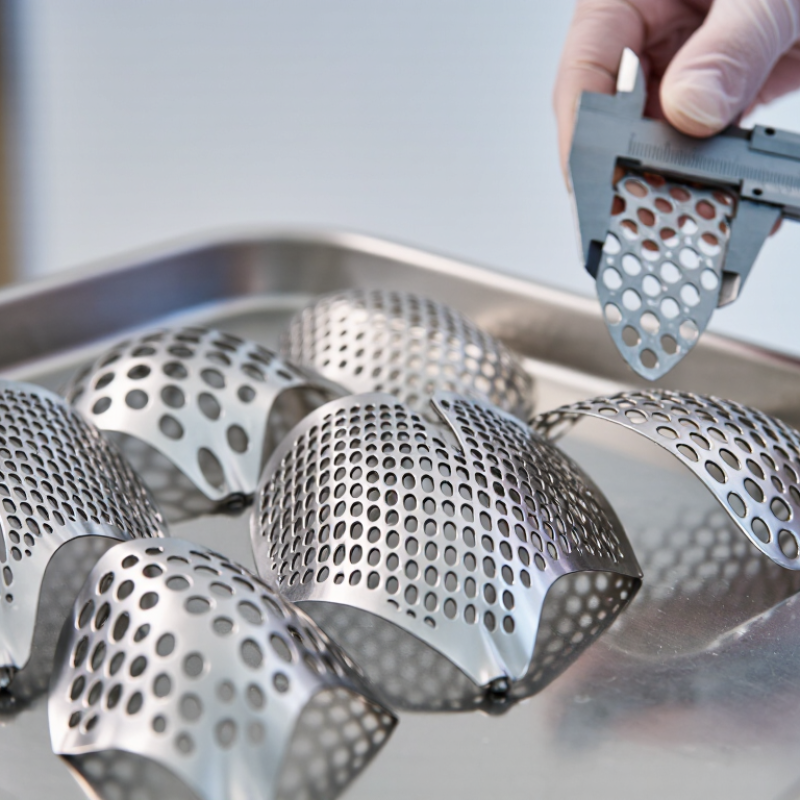
Pore size and mesh thickness influence handling, coverage, and structural support. Ask suppliers for measured pore dimensions, open-area data, thickness tolerances, and test methods. Compare the actual design drawings, not just catalog descriptions. Small details matter. A sharp edge or inconsistent opening can complicate contouring, yet bench measurements alone cannot predict clinical performance.
Fixation deserves equal scrutiny. Check screw-hole spacing, compatible fastener dimensions, and whether the mesh can be contoured without distorting its openings. For imaging, request material specifications and information on artifact testing. Titanium can still create artifacts, especially near the implant; results depend on the scanner and acquisition settings. Not always predictable. Confirm imaging plans with the treating team rather than relying on broad supplier claims.
Published outcome data also need careful reading. Yadla et al.’s systematic review, “Complications of Cranioplasty Following Decompressive Craniectomy” (Surgical Neurology International, 2011), reported a 15.9% overall complication rate across included studies. That figure covers varied materials and patient groups; it does not identify an ideal pore size or thickness. A dependable supplier should distinguish published clinical evidence from its own mechanical test data. I would still want clearer, comparable reporting across mesh designs.
| Evaluation Dimension | Design Data or Comparison Points | What to Check When Evaluating a Supplier | Clinical and Practical Considerations |
|---|---|---|---|
| Pore size and open area | Mesh openings vary by design; cranial products may offer openings in the approximate 1–3 mm range. Confirm the stated opening dimensions and whether they refer to the aperture or the center-to-center spacing. | Request a dimensioned drawing or technical specification showing aperture size, strand width, and open-area percentage. | Larger openings can improve visibility and access through the mesh, while smaller openings provide a different balance of coverage and flexibility. Selection depends on defect geometry, contouring needs, and the intended reconstruction. |
| Sheet thickness | Thin cranial mesh sheets are commonly offered in roughly the 0.4–0.6 mm range, although available thicknesses vary by product and design. | Verify nominal thickness, manufacturing tolerance, and whether the stated value applies to the sheet, formed mesh, or a specific region. | Thickness alone does not establish strength or suitability. Consider the complete design, defect location, intended fixation, and the device’s validated instructions for use. |
| Material and traceability | Implantable cranial mesh may be manufactured from commercially pure titanium or a titanium alloy; the exact material is product-specific. | Ask for the exact alloy or material designation, applicable material standards, lot traceability, and documentation for the finished implant. | Do not infer material composition from the general term “titanium.” Confirm the material and approved use in the product labeling and regulatory documentation. |
| Contourability and edge finish | Mesh designs differ in flexibility, cuttability, and resistance to deformation during shaping. These properties cannot be reliably compared from thickness alone. | Review handling instructions, permitted trimming methods, edge-finish requirements, and any available mechanical or usability test information. | Contour should be assessed for the specific anatomy and surgical plan. Avoid sharp or irregular edges and follow the manufacturer’s instructions for preparation and handling. |
| Fixation compatibility | Fixation may use dedicated cranial screws or other system-specific components. Hole size, hole pattern, screw dimensions, and driver compatibility vary. | Confirm compatible fixation components, screw dimensions, available lengths, required instruments, and whether components are intended to be used together. | Fixation strategy and placement are determined by the surgeon based on anatomy and the device instructions. Do not assume that screws from different systems are interchangeable. |
| Imaging and MRI information | Titanium is generally weakly magnetic, but MRI conditions and image artifacts are device- and configuration-specific. Titanium implants can still affect CT or MR images. | Request the exact MRI safety labeling, including any MR Conditional conditions, and imaging or artifact information where available. | Never treat “titanium” as sufficient evidence of MRI safety. Follow the implant’s labeling and the imaging facility’s screening procedures; artifact depends on the implant and imaging protocol. |
| Available shapes and sizes | Suppliers may offer flat sheets, preformed contours, or multiple sheet dimensions. Availability and configuration are product-specific. | Check size options, dimensional tolerances, contour options, packaging, and whether the supplied configuration matches the intended procedure. | Fit and coverage should be evaluated for the individual defect and surgical plan. A catalog size does not establish suitability for a particular patient. |
| Quality and regulatory documentation | Documentation requirements depend on the market and the product’s regulatory status. Relevant records may include quality-system certification, device registration or authorization, and product-specific labeling. | Verify current documentation for the destination market, sterilization status, shelf life, packaging integrity, and instructions for use. | Regulatory status and intended use must be confirmed for the exact device and jurisdiction; supplier claims should be checked against official documentation. |
Selection note: Dimensions above are indicative evaluation points, not universal specifications or clinical recommendations. Product ranges vary; confirm all measurements, compatibility, approved indications, and imaging conditions in the current product documentation and instructions for use.
Choosing a titanium mesh supplier requires more than comparing sheet thickness or pore patterns. ISO 13485 certification can indicate a structured quality-management system, but it does not guarantee every product or production site is covered. Check the certificate’s scope, validity, and listed locations. Ask how the supplier controls raw-material sources, machining changes, cleaning, and batch traceability. A clear record should connect a finished mesh to its material lot and inspection results.
Review ISO 10993 evidence for the specific device, material, and manufacturing condition under consideration. Request the biological evaluation rationale and supporting reports, not just a statement that testing was completed. Surface treatments, residues, and sterilization can affect the evidence needed. Confirm that reports identify the tested sample and methods. A tidy certificate folder can still hide gaps; document inconsistencies deserve follow-up, even when they seem minor.
Tips: Ask for a sample batch record and a change-control example. Check whether test reports match the supplied mesh’s finish and processing. If an answer is vague, request clarification in writing. Supplier documents can be dense, and review takes time. That is worth acknowledging.
A credible 2026 supplier ranking for cranial titanium mesh should begin with documented quality controls, not catalog claims. Check whether the supplier maintains an appropriate medical-device quality system, such as ISO 13485 certification, and confirm its scope and current validity. Request material certificates, applicable specifications, inspection records, and evidence that product dimensions match approved drawings. A certificate alone is not enough. Ask how nonconforming mesh is identified and contained.
Sterilization deserves its own score. Confirm whether mesh arrives sterile or requires processing, and request validation documents for the stated method and packaging. Traceability should link each unit to its material lot, manufacturing record, and inspection results. Test the paperwork with a sample order. Can one mesh panel be traced back quickly? Small detail. Real impact. Compare routine and custom lead times separately, including time for design approval and documentation. Ask how delays are communicated and whether urgent orders disrupt quality checks.
A weighted scorecard can make comparisons clearer, but it is not proof of clinical suitability. Specifications and evidence still need careful review. A tidy spreadsheet can miss a weak link. Recheck it.
Its density is about 4.43 g/cm³, and its elastic modulus is near 110 GPa. These values describe the material, not finished-mesh performance. Geometry matters.
Request measured pore size, strand width, thickness tolerances, and open-area data. Ask for drawings and inspection records. Catalog descriptions may leave gaps.
Hole patterns, thickness, and fixation points affect how a mesh responds to load. Bending can also alter openings. Bench figures alone cannot predict clinical performance.
Compare screw-hole spacing with compatible fastener dimensions. Ask whether contouring can distort the openings. Small details matter.
It can create artifacts near the implant. Results depend on the scanner and acquisition settings. Confirm imaging plans with the treating team.
A 2011 review reported this rate across varied studies, materials, and patient groups. It does not identify an ideal mesh design. The comparison has limits.
Request current quality-system documentation, material certificates, inspection records, and lot-level traceability. Check how nonconforming mesh is identified and contained. Paperwork should connect.
Confirm whether the mesh arrives sterile or needs processing, and request validation documents. Compare routine and custom lead times, including design approval. Delays happen. Recheck the details.
Choosing Titanium Mesh For Cranial Repair in 2026 begins with understanding material options. ASTM F67 covers commercially pure titanium, while ASTM F136 specifies Ti-6Al-4V ELI, a titanium alloy commonly considered for implant applications. Ti-6Al-4V has a density of approximately 4.43 g/cm³ and an elastic modulus of about 110 GPa. Material selection should be guided by the intended application, engineering requirements, and relevant clinical and regulatory review.
Mesh performance also depends on pore size, thickness, fixation features, and imaging needs, which should be assessed alongside the surgical plan. When evaluating suppliers, review their ISO 13485 quality systems, documented ISO 10993 biocompatibility evidence, sterilization controls, product traceability, and stated lead times. A reliable comparison should weigh these factors consistently and verify supporting documentation rather than relying on claims alone.

Synoviq Medical